Fly or Sail the Drake Passage?
Should you sail the Drake Passage, fly over it, or do one of each? It’s one of the questions my clients ask most often when planning an Antarctica trip, especially if they’re worried about seasickness.
Sailing the Drake Passage takes roughly two days each way, with the exact crossing time depending on sea conditions. Most traditional Antarctic Peninsula cruises begin and end in Ushuaia, Argentina. The crossing gives you time to settle into life aboard the ship, attend talks from the expedition team, and watch for seabirds as you make your way toward Antarctica.
Flying offers a shorter route across the Drake. Most fly-cruise itineraries use charter flights from Punta Arenas, Chile, to King George Island in the South Shetland Islands, near the Antarctic Peninsula. The flight takes about two hours, followed by a transfer to your expedition ship, usually by Zodiac. You then explore Antarctica by sea. Flights depend on suitable weather, so the shorter crossing comes with the possibility of delays.
You can choose to sail both ways, fly both ways, or fly one way and sail another. That makes it four possible routes to consider.
Fly or sail the Drake Passage: the four routes
| Route | Sea crossings | Antarctic flights | Main advantage | Main consideration |
|---|---|---|---|---|
| Sail both ways | Two | None | Experience the full journey to and from Antarctica by sea | Allow roughly two days for each Drake crossing, with sea conditions that cannot be predicted far ahead |
| Fly both ways | None | Two | Avoid the long sea crossings and make a shorter itinerary possible | Both flights depend on suitable weather at the Antarctic airfield |
| Sail south, fly north | One, on the way to Antarctica | One, on the way back | Arrive by sea without sailing the Drake twice | A delayed return flight can affect your onward plans |
| Fly south, sail north | One, on the way back | One, on the way to Antarctica | Avoid the outbound sea crossing while still experiencing the Drake by ship | A delayed outbound flight can reduce your time exploring Antarctica |
How rough is the Drake Passage?
The passage between South America and the South Shetland Islands is exposed to strong winds and large swells. Travelers call a calm crossing the Drake Lake and a rough one the Drake Shake. You could encounter either during the Antarctica cruise season.
January is peak Antarctic summer, but it does not guarantee calm seas. November and March sit toward the beginning and end of the main season, yet their crossings are not predictably rough. Even the southbound and northbound legs of one expedition can feel different.
I would choose your departure month for the wildlife, ice, and itinerary you want. Prepare for the possibility of motion at sea regardless of the date.
What happens while you sail the Drake?
Expedition teams generally use the crossing for safety briefings, lectures, and preparation for landings. When conditions allow, there is also time on deck watching seabirds and looking for the first icebergs.
If you feel unwell, rest. You may miss a talk or a wildlife sighting, but you do not need to attend every event to enjoy the expedition once you reach Antarctica. Make sure you receive any required safety briefing, and let the crew know if you need help.
On my own trip, the southbound crossing was cold but manageable. We encountered more noticeable swells on the way north. I was wearing a scopolamine patch and added acupressure wristbands. I spent much of one day lying on my bed, then felt better and went out to eat. The crossing was uncomfortable for a while, but it did not define my Antarctica experience.
How can you prepare for seasickness?
Make your medication plan before leaving home. Motion-sickness medicine generally works better when taken before symptoms begin, and the options have different side effects. Ask your doctor or pharmacist which is appropriate for you, especially if you have another health condition or take other medication.
| Option | Practical guidance |
|---|---|
| Prescription scopolamine patch | Ask your clinician whether it is suitable for you and when to apply it before the crossing. It is worn behind the ear. |
| Over-the-counter medication | Ask a doctor or pharmacist about options such as meclizine or dimenhydrinate, including when to take them and whether they may make you drowsy. |
| Cabin location | If you are prone to motion sickness, consider a lower cabin near the center of the ship when booking. |
| Horizon view | When you feel able to be outside, looking toward the horizon may help. Avoid reading or scrolling if it makes symptoms worse. |
| Rest, fluids and light food | Lie down if needed, sip fluids and eat something plain when you feel ready. You do not need to attend every lecture during the crossing. |
| Ship's medical team | Seek help if symptoms persist or you cannot keep fluids down. Make your own medication plan before departure rather than relying on what may be available aboard. |
| Acupressure wristbands | Are they placebo? Who knows?! But they did help me. |
What is a fly-the-Drake trip like?
On most fly-cruises, a charter aircraft travels between southern Chile and King George Island in the South Shetland Islands. Depending on your route, you meet or leave the expedition ship there. The transfer between shore and ship commonly involves a Zodiac, so this feels like part of the expedition rather than an arrival at a conventional cruise terminal.
Flying both ways only removes the long Drake crossings by sea. You still travel aboard the ship among Antarctic locations, and Zodiac outings remain part of the experience.
Check the flight route carefully. A package may include a flight from Buenos Aires to Ushuaia, where passengers board a ship and sail the Drake. That flight is useful, but it is not a fly-the-Drake itinerary.
Can the flight be turbulent?
Possibly. These flights can encounter turbulence, and the approach to King George Island may feel different from landing at a major commercial airport. There is no reliable way to predict how smooth your particular flight will be. For someone worried about motion, the duration is the practical distinction: roughly two hours in the aircraft versus roughly two days on the ship for each Drake crossing.
Trying to Choose Between Flying and Sailing the Drake?
Tell me your travel dates, how you feel about the sea crossing and how much flexibility you have after the trip. I can compare the routes, ships and flight arrangements that fit your plans.
COMPARE ANTARCTICA ROUTESWhat happens if an Antarctic flight is delayed?
Flights to and from King George Island need suitable operating conditions. The effect of a delay depends on which direction you are flying.
If your outbound flight is delayed, you may wait in Chile while the operator looks for a suitable flying window. The ship’s plans may be adjusted, which could reduce your time exploring Antarctica. A prolonged delay can lead to the voyage being interrupted or canceled under the operator’s contingency policy.
A one-day delay does not necessarily mean exactly one lost day ashore. The operator may rearrange the schedule, although its ability to do so is limited by the remaining voyage time and conditions.
If your return flight is delayed, you may have to remain aboard the ship beyond the scheduled end of the trip. That can affect an international flight home, work, or a fixed event. Ask what the operator provides during a delay and whether changing independently booked onward flights is your responsibility.
| Delayed flight | Possible effect on the expedition | Possible effect on your other plans | Ask before booking |
|---|---|---|---|
| Flight to Antarctica | You may wait in Chile while the operator seeks a suitable flying window. The voyage may be adjusted or shortened; a prolonged delay can trigger the operator's cancellation or interruption policy. | You may spend less time exploring Antarctica than planned. | How long will the operator continue trying to fly, and what happens if the voyage cannot proceed? |
| Flight from Antarctica | You may remain aboard the ship beyond the scheduled end of the voyage while waiting to fly out. | You could miss an international connection, work or another fixed commitment. | What support is provided during the delay, and who pays to change independently booked onward flights? |
How do I choose?
| If this matters most | Consider | Why |
|---|---|---|
| History of severe seasickness | Fly both ways | Avoids two extended open-ocean crossings. |
| Serious fear of the Antarctic flight | Sail both ways | Removes the King George Island flight entirely. |
| Limited vacation time | Fly both ways | Makes a shorter Antarctica itinerary possible. Leave room for a flight delay. |
| The full journey by sea | Sail both ways | Includes both the approach to Antarctica and the return voyage. |
| Experience the arrival by sea, but sail the Drake only once | Sail south, fly north | Preserves the southbound crossing while avoiding a second one. Allow flexibility after the trip. |
| Sail the Drake once, with an important commitment after the voyage | Fly south, sail north | Places the weather-sensitive Antarctic flight before the ship voyage home. Keep a buffer after disembarkation. |
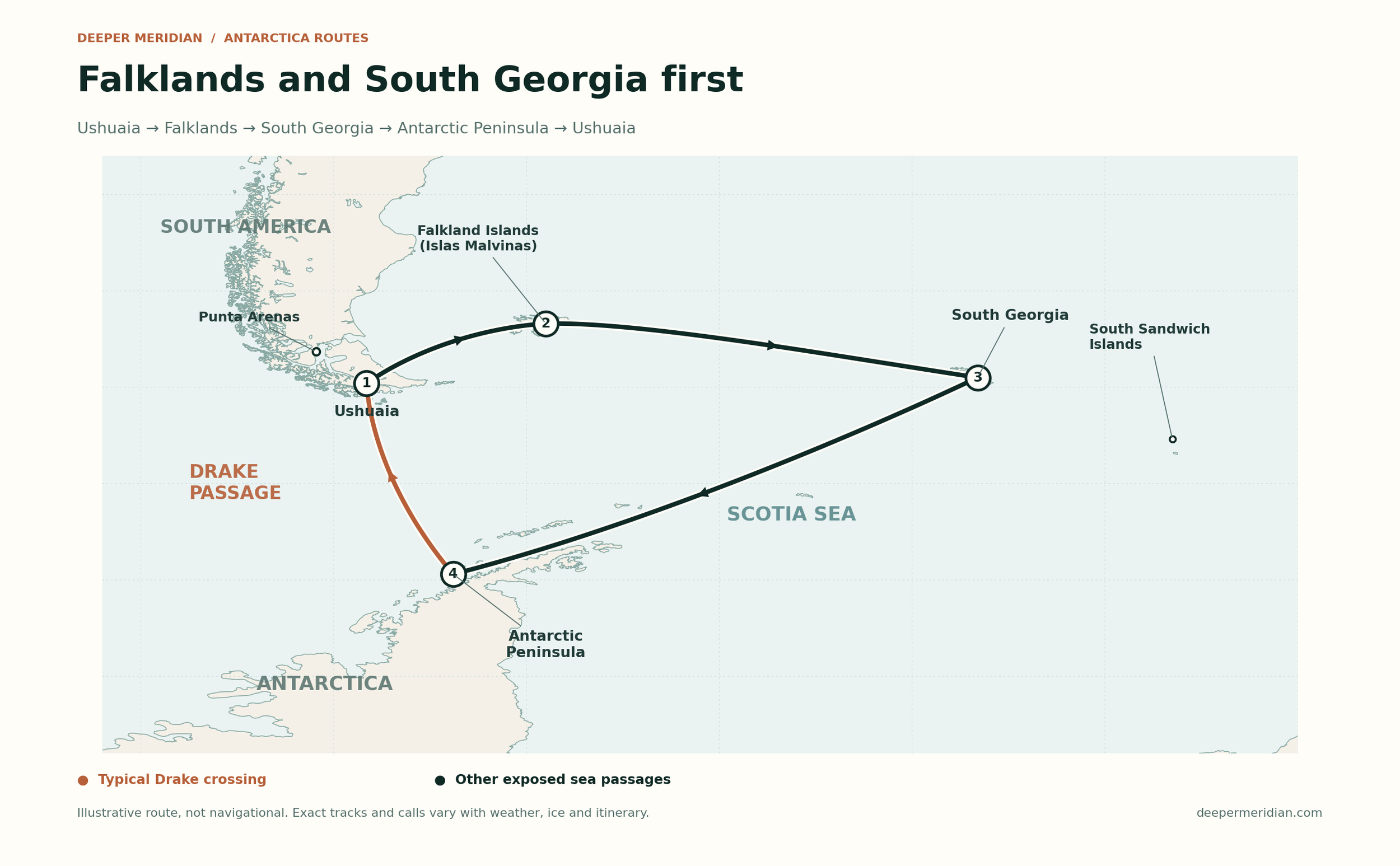
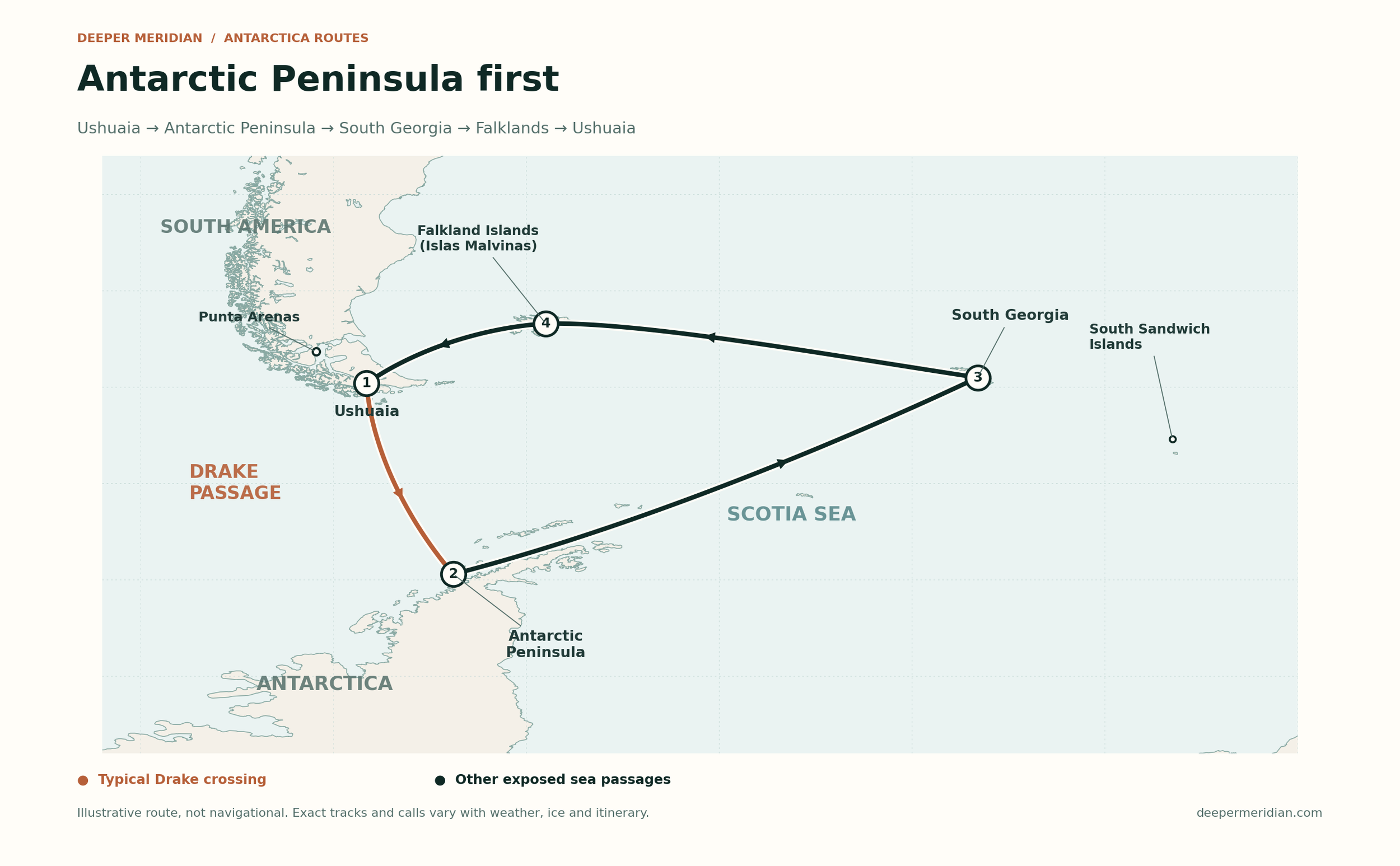
| Avoid an Antarctic flight and cross the Drake only once | South Georgia and Falklands loop | Some routes make one Ushuaia–Peninsula Drake crossing, but include more days at sea, including the Scotia Sea. |
A one-way fly-cruise gives you one Drake crossing by ship and one Antarctic flight. It is an appealing option for travelers who want to experience the passage at sea without crossing it twice. The direction determines where the flight risk sits.
Sail south, fly north gives you the gradual approach to Antarctica by sea. I would start with this route if that arrival appeals to you and you can allow extra time after the scheduled return. Poor conditions for the flight out can disrupt your onward plans.
Fly south, sail north removes the outbound Drake crossing by ship. A delayed flight could reduce the beginning of your Antarctic time, but your scheduled return from Antarctica is by sea. I would examine this direction first if you want to sail once and have a firm commitment after the trip.
Not every operator offers both directions. Check the route for the departure you are considering.
Can a South Georgia itinerary eliminate the Drake?
It won’t eliminate but it can reduce the Drake to just one crossing. Longer voyages link the Antarctic Peninsula, South Georgia, and the Falkland Islands in a loop rather than sailing directly between Ushuaia and the Peninsula in both directions.
One common route sails from Ushuaia to the Falklands, South Georgia, and then the Antarctic Peninsula. It crosses the Drake on the final leg back to Ushuaia. The reverse route sails the Drake first, then travels from the Peninsula through the Scotia Sea to South Georgia and the Falklands before returning to Ushuaia. Check the day-by-day itinerary, since routes and ports vary.
This is worth considering if you want to avoid an Antarctic charter flight and limit the Ushuaia–Peninsula Drake crossing to once. It also gives you South Georgia’s king penguin colonies and the wildlife of the Falklands, which are strong reasons to choose the longer voyage in their own right.
One thing to note: Yes, the Drake Passage is more notorious for rough crossings, but the Scotia Sea is not reliably calm. The voyage between the Antarctic Peninsula and South Georgia crosses exposed water and could bring some wind and swell. A South Georgia itinerary may reduce your Drake crossings to one; it does not reduce your overall time at sea. If severe seasickness is your main concern, I would still start with flying both ways.
Which route would I recommend?
For someone with a history of severe seasickness, I would start with flying both ways. Medicine may make a crossing manageable, but there is a sound reason to avoid two extended stretches of open ocean when you already know how strongly you react.
For someone with a serious fear of the Antarctic flight, I would start with sailing both ways. A one-way itinerary still requires that flight, so it does not resolve the concern.
If vacation time is limited, flying both ways opens up shorter trips. Compare how many days are planned in Antarctic waters, not just the advertised package length, and leave room for a flight delay.
If the voyage by sea is part of what draws you to Antarctica, sail both ways. The crossing gives you time to move gradually from South America into the Antarctic environment and to settle into life aboard the ship.
If you have an important commitment soon after the expedition, I would favor an itinerary scheduled to return by sea over one that relies on a flight out of King George Island. Ships can also arrive late, so keep a buffer after disembarkation.
What if your family or group cannot agree?
Begin with the concern that could prevent someone from enjoying the expedition. A preference to avoid swells is different from a history of debilitating seasickness.
If one traveler is highly prone to seasickness and the others are comfortable flying, I would choose fly both ways. If the group handles ships well but someone has a serious fear of the Antarctic flight, I would choose sail both ways.
For moderate concerns on both sides, I would examine sail south, fly north first. Everyone experiences the arrival by sea, and there is only one Drake crossing aboard ship. If a group member has an immovable commitment after the trip, I would instead examine fly south, sail north and still allow time after disembarkation.
Which operators offer fly-the-Drake itineraries?
| Operator | Fly both ways | Fly one way, sail one way |
|---|---|---|
| Quark Expeditions | Antarctic Express: Fly the Drake and selected Crossing the Circle itineraries | Fly South, Sail North and Sail South, Fly North |
| National Geographic–Lindblad Expeditions | Antarctica Direct: Fly the Drake Passage | Antarctica Direct: Sail and Fly the Drake Passage sails south and flies north |
| Antarctica21 | Classic Antarctica Air-Cruise and Polar Circle Air-Cruise | Antarctica Express Air-Cruise combines a sea voyage with one Antarctic flight; check its route and time exploring the Peninsula |
| Silversea | Selected King George Island round-trip voyages | Selected voyages between King George Island and Puerto Williams, in either direction |
| Aurora Expeditions | Antarctic Peninsula: Fly the Drake | No one-way option listed in the cost guide |
The fly-cruise options in my Antarctica cost guide include Quark Expeditions, National Geographic–Lindblad Expeditions, Antarctica21, Silversea, and Aurora Expeditions. Some offer flights both ways; selected voyages combine one flight with one sea crossing.
What should you confirm before booking?
Ask for the full day-by-day route and the operator’s flight contingency terms.
Confirm how many days are planned in Antarctica, what is included in the fare, and what happens if a flight cannot operate.
If you are sailing the Drake, settle your seasickness plan before you leave home.
Check what your travel insurance covers for weather delays and missed connections, particularly when your international flights are booked separately.
The crossing is worth planning for, but it should not dominate the expedition you choose. Select a route you can manage, allow room for the weather, and arrive ready to enjoy Antarctica.
Ready to Choose Your Antarctica Expedition?
I can compare the ships, crossing routes and flight policies for your travel dates, then help you choose an expedition you can look forward to from the start.
START PLANNING YOUR ANTARCTICA EXPEDITIONAuthor Bio
I’m a Polar travel advisor and IAATO Antarctic Ambassador, with in-depth training on Antarctia ships, itineraries and polar experiences. I’ve also sailed Antarctica, so I bring both formal training and firsthand experience when helping travelers choose the right expedition.
Thumbnail Pic Courtesy: Aurora Expeditions.